

OWL HOOT 567

The DTU Executive
Louisa Hadley, President
President@dtu.qc.ca
Brian Seivewright, VP Internal
VPInternal@dtu.qc.ca
Mélanie Beck, VP External
VPExternal@dtu.qc.ca
Antonia Fikkert, Secretary-Treasurer
Secretary_Treasurer@dtu.qc.ca
Emilie Richer, Grievance Officer
grievanceofficer@dtu.qc.ca

Administrative Assistant
Elisabeth Leone
Elisabeth@dtu.qc.ca
DTU email: dtu@dtu.qc.ca
In this issue:

Welcome message
Faculty Vacation dates
French Survey Results
Updates to CA
Health and Safety
DTU Annual Party
Elections and GA
GOS Entente
Upcoming Leaves deadlines
Professional Development Funds
Your Rights, Explained

We hope that you enjoyed the March break and that the semester is going well. As always, the DTU Executive invites you to drop by our office in 8A.11. We can answer questions regarding workloads, seniority and priority, schooling and work experience documentation, and anything else related to working at Dawson. In particular, before turning down work we encourage you to come and discuss the implications with us. We always recommend copying us into communications with the College so that we can help to make sure that your rights are protected. You can also call us at local 1799, or email us at dtu@dtu.qc.ca with any questions.

Faculty Vacation and Availability

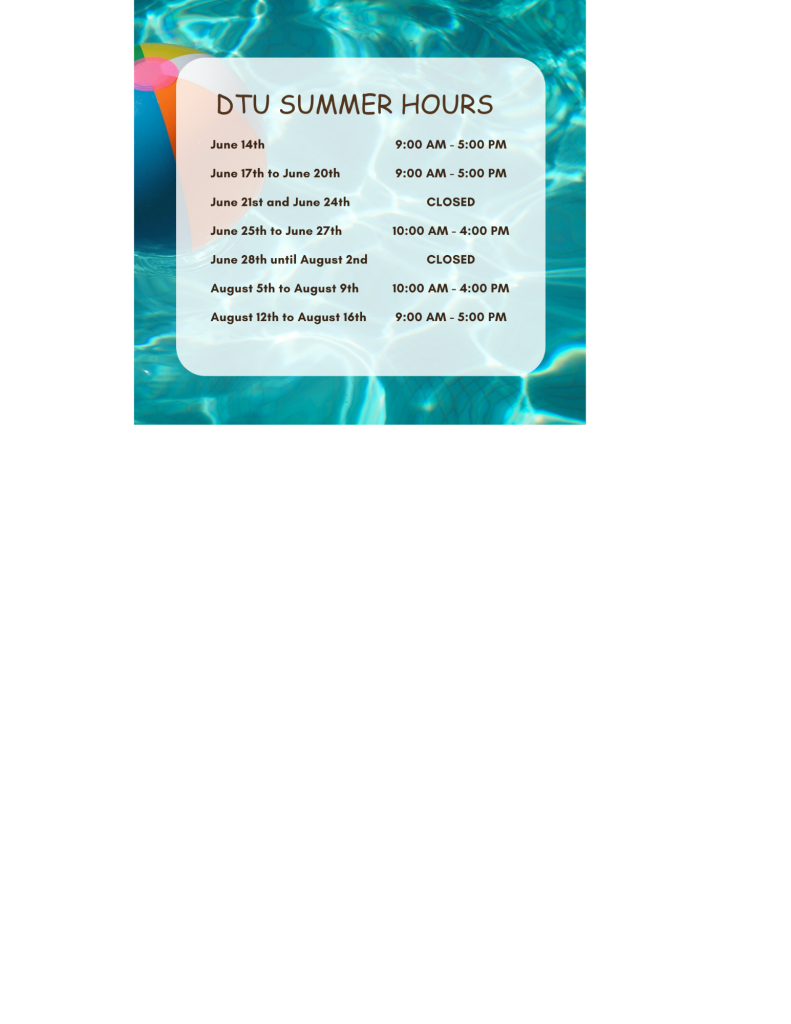
For teachers with a day contract or a Cont. Ed. charge, the last day of availability for this academic year is June 13. The vacation period is from June 14 to August 18, inclusive. Teachers are expected to be available to the College until the vacation period begins. Although the nature of our work alters after classes end, teachers are expected to be available to attend meetings with the College if required. For full-time teachers, availability is 32.5 hours per week. For part-time teachers, availability is proportional to the workload.

Given the Fall 2024 Academic Calendar has classes starting on August 19, there are no days of faculty availability before classes begin. Additionally, availability ends in June only two days after the Grade deadline; we are especially concerned about precarious teachers who often receive their workloads only after the end of availability in June. We asked the College to consider altering the Academic Calendar to allow more time for faculty to prepare for classes. However, the Academic Calendar recently sent to the community confirmed that they have not altered the start date of Fall semester classes. 

The Academic Calendar seems to prioritize “study days” over availability for faculty to prepare classes. However, when Senate voted on the Academic Calendar the faculty vacation period had not been set and so Senators did not have complete information regarding availability.  We have advised the College that if they maintain the current Academic Calendar, this will impact the level of preparedness for the start of the semester, in terms of classes as well as staffing. However, the College has indicated that since Senate has pronounced itself on the matter already, it will leave it to Senators to bring back any issues if they believe it to be necessary.

We remind you that you do not have to work during the vacation period and that the College cannot expect you to. We understand that this means that classes may not be prepared and that Course Outlines will be delayed. For coordinators, we remind you that you are not expected to work prior to the start of availability and ask that you contact us if the College requires you to work during the vacation period. 

Teachers who wish to be unavailable to the College prior to the beginning of the vacation period can request a transfer of availability. You need to complete the form provided by the College in advance of the period you are transferring. Note that the form asks what activities you propose to make up for the period of unavailability; you do not have to provide too much detail here. It is sufficient to indicate something along the lines of “course prep” or “departmental work”.  

French Survey Results

As you may recall, the College recently sent out a survey to all faculty regarding their ability and interest in teaching courses in French. This survey was co-sponsored by the DTU as we believe it is important for departments to have a clear and accurate view of their staffing capabilities in light of the introduction of courses to be taught in French. 

The survey has now closed and the Academic Dean’s office has shared the results with the DTU. Overall, 39.5% of respondents indicated that they were sufficiently proficient to teach in French. 16.5% of respondents indicated that they were both proficient and interested in teaching in French, with a further 14.6% who indicated they were proficient and “neutral” about teaching in French. 

The need for teaching in French varies greatly between departments, however, so it is important that individual departments initiate discussions regarding the staffing of the courses in your department that have been identified as those to be taught in French. We believe that it is important that these conversations happen at the department level and that they are fully transparent. The Academic Dean’s office has sent to each department its results, which take two forms: an overall summary of the results for your department as well as individualized responses from all faculty in your department. As a reminder, the survey was not anonymous and faculty were informed that this information would be shared with their department, so you should expect to receive it soon.

During these departmental discussions it is important to keep in mind the goal of minimizing the negative impacts of law 14 on faculty working conditions. The intention is to assign courses in French to those who expressed both an ability and willingness to teach them in the first instance. However, it may be necessary to assign courses to those who are able but expressed that they were neutral or not interested in teaching in French. This is important as it is the responsibility of all teachers to ensure the quality and the content of the courses offered in their department. Moreover, your department may need to consider how to distribute courses to be taught in French fairly so that they are not simply passed down the list to a teacher who may not be able to take them.

 It is also important to keep in mind that FNEEQ and the administrations of the anglophone cégeps are jointly negotiating an agreement with the government to introduce some protections into the Collective Agreement for those teachers who are unable to teach in French. The details are still to be finalised but possibilities that are being explored include a leave to protect the seniority of teachers who are unable to take on work as well as access to training for teachers who need additional support to be able to teach in French in the future. More details about these negotiations were presented in the February edition of the Owl Hoots. The DTU Executive is available to attend departmental discussions if requested. 

Update on the New Collective Agreement

The exact wording of clauses of the new Collective Agreement are still being finalised by the government and union negotiation teams. Given that the union negotiation teams are still waiting for the text from their government counterparts, it is unlikely the Collective Agreement will be signed before the end of May. Once the Collective Agreement has been signed, it will be in effect; we will then also know the time-frame for the retroactive salary payment. In the past, colleges have had 120 days from the date of signature to disburse the retro pay, but the union side is currently advocating for that to be reduced. We will communicate with all members once the Collective Agreement is signed and will provide more detailed information regarding the implications for salaries.

We would also like to take this opportunity to highlight some changes that will take effect once the new Collective Agreement is signed.

Professional Development Leave
The new Collective Agreement brings in deadlines for applications for a Professional Development Leave. For the Fall semester or the whole of the following academic year, the deadline will be May 15th; for the Winter semester the deadline will be November 15th

Online Teaching
The new Collective Agreement will bring in clearer guidelines about the development of online teaching in the Cegep network. Although the wording has not been finalised, it will include a statement that colleges privilege in-person learning and that online (or blended) learning must respond to a specific need identified in the community. In addition, there should be more active consultation of departments, programs, and senate in advance of the implementation of any online teaching projects as well as more opportunities for these groups (and the Union) to ask for an evaluation of the projects. 

Modified CI formula for 30-hr-course workloads
In the past, the number of students in 30-hour courses was not taken into account for the NES factor in CI calculations. Under the new Collective Agreement, there will be a specific formula applied to calculate the NES factor for workloads including 30-hour courses. The NES factor takes into account the number of students a teacher has in a given semester and thus is a significant gain for Physical Education teachers who often have 200 students a semester. 

Post-Creating EESH resources
Our previous collective agreement required that a minimum of 35% of EESH resources (Soutien à la réussite scolaire des étudiantes ou des étudiants en situation de handicap) be used to create permanent positions. Despite our repeated requests to the College to increase this percentage, the College refused and purposefully injected these resources parsimoniously in many disciplines to avoid creating permanence. The minimum has now been increased to 75%, which corresponds to an increase from 2 ETC to 4 ETC of resources. This gain will hopefully stabilize the resources departments obtain from this envelope and possibly create new permanent positions. 

Health and Safety at Dawson

There have been some recent changes in the law regarding how employers have to handle health and safety issues in the workplace. Although these changes came into effect in April 2022, some of the practical applications have only recently been implemented at Dawson. We wanted to take this opportunity, therefore, to provide some updates.

Health and Safety Committee – there is a Health and Safety Committee at Dawson which brings together College representatives as well as representatives from the three employee unions (DTU, DSSU, ADP) and a student representative. The Committee usually meets two or three times a semester and has a mandate to make recommendations to the College regarding health and safety issues as well as prevention activities. If you are aware of any health and safety concerns that you feel should be addressed by the Committee, we encourage you to inform us at dtu@dtu.qc.ca

Health and safety Representative – the new law brought into effect a single Health and Safety Representative for all employees. For this year, the Health and Safety Representative is Serge Corchia from the DSSU. This position comes with release to allow the representative to follow up on all situations related to health and safety at the College. For the remainder of this semester, Serge Corchia will be working on this dossier on Wednesdays – you can reach him either in the DSSU office (8A.9) or via email at scorchia@dawsoncollege.qc.ca. Of course, you can contact him at any time for more urgent issues. We encourage you to copy the DTU in all communications with the Health and Safety Representative.

Emergencies – In cases of emergency, you should call security at 1000. Note that although these calls go to the main Security desk, they are indicated as an emergency call, so the person answering should be aware that it is an emergency situation. We have heard in the past about issues with security guards asking members of the community to speak in French; we have been assured that almost all security guards are able to communicate in English and that in the case of an emergency there would be someone available who could respond in English.

Accidents and Incident Reports If you experience an accident or incident at the College, it is important that you complete the reporting form, which can be found online here, and make sure to inform the DTU. Even if the incident does not seem serious, it is useful for the Health and Safety Committee to be able to assess trends and identify possible areas to be addressed.

Due to the strike last semester, we were not able to host our usual annual party to celebrate new perms and retirees. We are happy to announce that there will be a delayed party on Thursday, May 23rd, which is the last day of classes. The party will feature all the usual food, drink, and collegiality so come join us to celebrate your colleagues and the end of the year!

Note: the College is also organising a replacement for its holiday party on May 3rd! The College is asking for RSVPs on omnivox by April 17th. We tried to coordinate the two parties but unfortunately the numerous activities scheduled for May has made it impossible.

Mark your calendars with these two opportunities to celebrate with your colleagues!

Election Season

The DTU Election period for 2024-2025 is approaching. We will be holding elections for all DTU positions as well as positions on the Senate and Board of Governors. If you are interested in getting involved or would like to know more about the positions and what is involved, we encourage you to speak to us. 

The nomination period will run from April 8th to 24th; an email will be sent to all members with the nomination form and information on positions available. Once the nomination period has closed, candidate statements for union-wide positions will be sent to all members.

Candidates for DTU-wide positions will present themselves at the next General Assembly and the voting period will open at the end of the meeting. The voting period will continue in the Upper Atrium for at least one additional day. Full details of when and where to vote will be sent to all members. The date of the General Assembly will be announced after the Executive Council meeting on April 10th, and will likely be in late April.

General Offer of Service (GOS)

As was the case last year, the College and the Union have reached an agreement to have an “automatic” General Offer of Service (G.O.S.) process for the coming academic year. This means that non-permanent teachers will not need to complete a form to exercise their priority for workloads for the coming academic year.

Specifically, this means that non-permanent teachers will automatically be considered as exercising their priority on all available workloads for Fall 2024, and Winter 2025, and Summer 2025. You can still accept or refuse work depending on your particular circumstances, though we always advise you to consult with the DTU before refusing a workload to make sure that you understand the implications for your future hiring priority. 

Although your coordinator may inform you of your workload, it is important to know that this is only provisional. The official confirmation of workloads is done by Human Resources once they have completed relevant verifications, and will be subsequently communicated to you. 

Important Reminder: individual teachers have an obligation to ensure that their double employment status is updated with the College. Any teacher who has a full-time contract outside of Dawson, or who has a reasonable expectation of full-time employment for a given semester, is considered to be double employed when exercising their priority on a teaching workload at Dawson. If you are newly in a situation of double employment, or are no longer double employed, you should inform HR by emailing hrfaculty@dawsoncollege.qc.ca. If you are unsure whether your situation constitutes double employment, we encourage you to contact us at dtu@dtu.qc.ca.   

Professional Development Funds

Professional Development Funds are available to all faculty (whether in the Regular or Cont. Ed. sector) and can be used to fund professional development activities such as attending workshops, participating in conferences, and taking courses. Teachers can also apply for a reimbursement of up to $100 for computer equipment.

For your request to be considered at the next meeting of the Professional Development Fund Committee, submit it as soon as possible at room 8A.11 or by email (pdfsecretary@dawsoncollege.qc.ca).

We ask that applications be submitted prior to the date of the proposed activity. The Committee will be meeting to review applications the following week.

Your Rights, Explained

Teacher Evaluations
The Office of Academic Development is in the process of sending out information to faculty who are being evaluated this semester. So, we wanted to take this opportunity to remind you of your rights and responsibilities regarding this process.

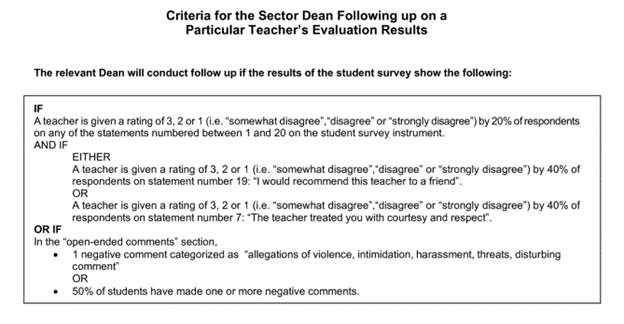
The DTU does not endorse the College’s process of evaluating teachers for various reasons; in particular, numerous research studies (see for example Peterson et al 2019 or Kreitzer and Sweet-Cushman 2021) have shown that student evaluations are subjective and biased, especially towards faculty from minority groups. We have repeatedly brought up our concerns about these evaluations with the College and take particular issue with the question “would you recommend this teacher to a friend.” Despite this, the College continues to use the existing evaluations.

Teachers cannot opt out of the evaluation process; however, we recommend that teachers do not participate in any self-assessment that may be requested as part of the evaluation as this lends credence to what we believe is a flawed process.  

Although you cannot opt out of the evaluations, you can ask for them to be rescheduled. If the timing of the evaluations is not appropriate for your class schedule, you can request that the Office of Academic Development reschedule it to another date in the semester. If you feel that an evaluation in a given semester would not be appropriate based on your circumstances (whether pedagogical or personal), you can ask your Sector Dean to delay the evaluations. Note, this usually delays the evaluations by only one semester. 

In normal circumstances, Regular Day teachers (whether permanent or not) can expect to be evaluated 1 out of every 4 semesters on a random basis. This means that it is possible for a teacher to be selected for evaluation in consecutive semesters. However, if a teacher’s evaluation is “flagged” by the Dean then they can expect a more frequent evaluation schedule (1 out of every 2 semesters). Teachers who have been flagged should receive an email from their Dean; however, if you feel that there is an issue with the frequency of your evaluations, you should write to your Sector Dean to ask for clarification as to whether you have been flagged. 

The DTU also has concerns regarding the College’s policy for flagging evaluations. We recently learned that the flagging process is done by someone external to the College and that these are meant to be reviewed by the Sector Dean to determine whether the flag is warranted.

It is problematic that the responses to the question “I would recommend this teacher to a friend” are given so much weight in the flagging criteria. This question is extremely subjective and does not address a teacher’s abilities. There are many reasons for which a student would, or would not, recommend a teacher to a friend and we are concerned that this turns the evaluations into a popularity contest. In the age of RateMyProfessor, teachers already have to contend with students sharing information and making decisions about teachers before they’ve even experienced the classroom environment. 

If you have been flagged and are  convened to a meeting with your Sector Dean, a DTU Representative can accompany you. Email us at dtu@dtu.qc.ca to make the arrangements.

Your Rights, Explained

Grade Review Committee
While students’ rights and responsibilities regarding grade reviews are set out in ISEP, the Grade Review Committee is part of our Collective Agreement. 

Before a student requests a grade review, they should be encouraged to discuss the situation with their teacher. A student can request a grade review only once the final grade for the course has been submitted to the College. The student’s request must be submitted to the relevant Sector Dean within 30 calendar days of the official grade deadline of the semester. The Dean determines whether to grant a grade review request from a student, and in the event that the request is granted, they contact the department to ask that a Grade Review Committee be convened. 

A few things to keep in mind about how the Grade Review Committee functions:

  • It is an independent committee; the administration has no authority over how the committee functions.
  • It is composed of three teachers from the discipline, one of which is the teacher responsible for the original evaluation.
  • The committee determines among itself how it wishes to function; for example, whether to meet in person, whether to make its decision via email, the distribution of tasks among committee members.
  • The committee determines whether or not it feels it is necessary to meet with the student; the student has an obligation to present their case along with supporting evidence as part of the request process. 
  • The committee communicates its decision to the Dean; the committee can determine to increase, decrease or maintain the original grade.
  • The decision of the Grade Review Committee is final.

Dawson Teachers Union
3040 Sherbrooke, Westmount, Suite 8A.11
514-931-8731 ext 1799
dtu@dtu.qc.ca

Owl Hoots 566

The DTU Executive
Louisa Hadley, President
President@dtu.qc.ca
Brian Seivewright, VP Internal
VPInternal@dtu.qc.ca
Mélanie Beck, VP External
VPExternal@dtu.qc.ca
Antonia Fikkert, Secretary-Treasurer
Secretary_Treasurer@dtu.qc.ca
Emilie Richer, Grievance Officer
grievanceofficer@dtu.qc.ca

Administrative Assistant
Elisabeth Leone
Elisabeth@dtu.qc.ca
DTU email: dtu@dtu.qc.ca

In this issue:

Welcome Message
Executive Council Meetings
Local Activities
New Teachers –  Schooling and Experience
Law 14 Update
FNEEQ Guide for Inclusive Communication
Your Rights, Explained

The DTU Executive invites you to drop by our office in 8A.11. We can answer questions regarding workloads, seniority and priority, schooling and work experience documentation, and anything else related to working at Dawson. In particular, before turning down work we encourage you to come and discuss the implications with us. We always recommend copying us into communications with the College so that we can help to make sure that your rights are protected. You can also call us at local 1799, or email us at dtu@dtu.qc.ca with any questions.

Executive Council Meetings

Executive Council meetings are usually held once a month during the semester. The Agenda and Minutes are sent out one week in advance of the meeting, but if you would like to mark them in your calendar, the dates for this semester’s meetings are 4-6pm on March 6th, 4-6pm on April 10th, and 10am-12pm on May 27th. All members are welcome to attend Executive Council meetings. 

Local Activities

This semester there will be many opportunities to interact and mobilise with your colleagues. More information will be coming, but for now, mark your calendars! 

DTU Events

Law 14 drop-in session: 1-3pm Thursday, February 15th, Boardroom (5B.13)

International Women’s Day: Friday, March 8th

More details will be forthcoming. As always, we will need volunteers to help out with these events; please feel free to reach out if you are interested in volunteering!

External Events

Walk for Missing and Murdered Indigenous Women and Girls: 6pm Wednesday, February  14th, Cabot Square 

Action Coalition Main Rouge in relation to the global day for social justice: Noon Tuesday, February 20th. Downtown Montreal. Register online to receive the exact location: https://framaforms.org/inscription-action-coalition-main-rouge-fraca-du-20-fevrier-1706656479   

New Teachers – Schooling and Experience

As a reminder, teachers have 30 days from the date they are hired to provide the documents necessary for the College to evaluate your education and experience for pay purposes. As long as you provide the documents – or at least evidence that you have attempted to get the documents – within this timeframe, any impact on your pay will be retroactive to your hiring date. It is still worth submitting documents after this time, though any pay increases will only be retroactive to the date of submission. 

Law 14 Update

As the implementation of Law 14 (previously Bill 96) progresses, we wanted to provide an update on the negotiations with the government regarding the implications for our working conditions.

Implementation of Law 14 at Dawson

As a brief reminder, there are several aspects of Law 14 that have implications for Dawson and the courses we offer. The first phase of implementation requires that all non-certificate holders take the French Exit Exam prior to graduation. To prepare the students, starting in Fall 2023 the French department has been offering new courses with competencies designed to prepare students for the Exit Exam. This required modifications to the program grids that impacted on staffing for both complementary courses and some General Education courses.

The second phase of implementation requires that colleges prioritize admissions for certificate holders. Dawson has developed an admissions policy to reflect this which was officially in effect as of Winter 2024; since we do not admit many students in the Winter semester, the main impact of this will be seen with the admissions for Fall 2024.

Finally, the next phase is to implement the requirement that all students have 5 courses “of or in” French – whether the courses are French language courses or other courses taught in French depends on whether the students are certificate holders and their level of French. As a result of this, courses will begin to be offered in French in other disciplines. Programs have identified which courses will be offered in French, which in many cases will be a Humanities course. Although this phase is officially to be implemented starting in Fall 2024, the courses selected occur in the third semester, or later, of the program, so the impact will only be felt as of Fall 2025.

Survey on French Ability
Given that many departments will need to start offering courses in French, the College has decided to survey faculty on their French ability as a preliminary step to determine staffing needs. The DTU are co-sponsoring the survey and have been actively involved in its design; the College has also committed to sharing the results with the DTU.

The survey will be available on Omnivox soon and it will be mandatory. It is important that faculty participate so that, whenever possible, courses can be assigned to those who are both proficient and willing to teach in French.

Union Negotiations on Protections for Law 14

Separately from the Collective Agreement negotiations, the FNEEQ is negotiating with the government to develop a “lettre d’entente” addressing the changes to the working conditions of teachers in anglophone cegeps as a result of Law 14. The FNEEQ negotiating team includes two FNEEQ representatives as well as a teacher representative from an anglophone cegep; the teacher representative is DTU Executive member Émilie Richer. There are also discussions happening with the administration of the anglophone cegeps to develop a unified approach to increase the likelihood of the government agreeing. 

There are many possible elements being discussed at the moment, but the FNEEQ is hoping to get an agreement that includes:

  • a 5-year transition phase during which teachers who are unable to teach a course in French would be able to turn down the course without losing seniority and priority

  • access to a leave for professional development training for teachers whose French ability is not sufficient to teach courses in French in their discipline

  • recognition that the same course in a different language counts as a distinct preparation for CI calculation

The DTU will be holding a Law 14 drop-in session from 1-3pm on Thursday, February 15th in the Boardroom (5B.13). Members of the DTU Executive will be available to answer questions. 

FNEEQ Guide for Inclusive Communication

Le comité femmes and Le comité diversité sexuelle et pluralité des genres have developed a guide to promote inclusive communication in French with regards to gender. The guide provides some background and context as well as helpful tips regarding pronouns, titles, gendered endings, and neutral formulations. We encourage you to consult the guide here. The committees intend to adapt the guide for the English language in the coming months.

Your Rights, Explained

Availability

The collective agreement (Clause 8-3.00) specifies that full-time teachers are available to the college 32.5 hours per week from Monday to Friday (normally 6.5 hours/day). Part-time teachers must be available for a period equivalent to his/her teaching load as a proportion of a full-time load (specifically their C.I. for the semester ÷ 40 multiplied by 32.5 hours). Obviously many aspects of our work require presence at the College, but you are not necessarily expected to be at the College for all of your hours of availability. The collective agreement requires that you be at the college when your duties require it (e.g. teaching, department meetings, hiring committees) provided these duties fall within your 32.5 hours of weekly availability. Continuing Education teachers (without a charge course) do not owe availability beyond the hours of their course plus some student encadrement, fulfilled in the time and method of their choosing.

As a result of the College’s decision to revise the Academic Calendar and reschedule classes that were cancelled due to the strike, teachers who taught in the Regular Day sector in Fall 2023 owe less availability to the College this year. If you taught full-time in the Day, the College docked 52 hours of your pay and subsequently asked you to retake your course preparation, lecturing, and grading but to drop other tasks instead (part-time teachers would have been docked a proportional amount).

The Union’s position is that all of our tasks are essential and difficult to divide. We asked the College to remunerate us so that we can complete our tasks, but the College replied that it does not have the funds. It is very important that members follow the College’s directive to drop tasks and the motion passed by the General Assembly to protect the principles of collective labour action by declining to work without remuneration. Examples include committee work and departmental tasks such as annual reports, revisions, and meetings. Please contact the dtu with any questions or concerns on this issue. 

Special Leaves

Both Regular and Continuing Education faculty are eligible for special leaves without loss of pay under clause 5-9.01 of the Collective Agreement. These include short-term leaves: for the death of your spouse or a family member; for your wedding or a wedding in your immediate family; for moving; or due to an act of God preventing you from working. 

All teachers also benefit from up to ten days of leave for family reasons per year under clause 5-9.06 of the Collective Agreement. These leaves may be used for any obligations arising from the care or education of your child or your spouse’s child, or from the health of a spouse or a close relative (see the Collective Agreement for what is considered a close relative for the purposes of this clause). Up to six of these days may be claimed from your sick bank, if applicable. Half-day leaves are also possible.

Extended leaves for family reasons are available in exceptional circumstances. Feel free to contact the DTU for more information.

Note that our Collective Agreement does not provide personal days for anything beyond the reasons above.

If you need to avail yourself of one of these leaves, you must inform your sector dean in writing as soon as possible, and be sure to indicate the reason for the leave on the Certificate of Absence. You are encouraged to copy the DTU in your correspondence (dtu@dtu.qc.ca).

Owl Hoots 566

The DTU Executive
Louisa Hadley, President
President@dtu.qc.ca
Brian Seivewright, VP Internal
VPInternal@dtu.qc.ca
Mélanie Beck, VP External
VPExternal@dtu.qc.ca
Antonia Fikkert, Secretary-Treasurer
Secretary_Treasurer@dtu.qc.ca
Emilie Richer, Grievance Officer
grievanceofficer@dtu.qc.ca

Administrative Assistant
Elisabeth Leone
Elisabeth@dtu.qc.ca
DTU email: dtu@dtu.qc.ca

In this issue:

Welcome Message
Executive Council Meetings
Local Activities
New Teachers –  Schooling and Experience
Law 14 Update
FNEEQ Guide for Inclusive Communication

Your Rights, Explained

The DTU Executive invites you to drop by our office in 8A.11. We can answer questions regarding workloads, seniority and priority, schooling and work experience documentation, and anything else related to working at Dawson. In particular, before turning down work we encourage you to come and discuss the implications with us. We always recommend copying us into communications with the College so that we can help to make sure that your rights are protected. You can also call us at local 1799, or email us at dtu@dtu.qc.ca with any questions.

Executive Council Meetings

Executive Council meetings are usually held once a month during the semester. The Agenda and Minutes are sent out one week in advance of the meeting, but if you would like to mark them in your calendar, the dates for this semester’s meetings are 4-6pm on March 6th, 4-6pm on April 10th, and 10am-12pm on May 27th. All members are welcome to attend Executive Council meetings. 

Local Activities

This semester there will be many opportunities to interact and mobilise with your colleagues. More information will be coming, but for now, mark your calendars! 

DTU Events

Law 14 drop-in session: 1-3pm Thursday, February 15th, Boardroom (5B.13)

International Women’s Day: Friday, March 8th

More details will be forthcoming. As always, we will need volunteers to help out with these events; please feel free to reach out if you are interested in volunteering!

External Events

Walk for Missing and Murdered Indigenous Women and Girls: 6pm Wednesday, February  14th, Cabot Square 

Action Coalition Main Rouge in relation to the global day for social justice: Noon Tuesday, February 20th. Downtown Montreal. Register online to receive the exact location: https://framaforms.org/inscription-action-coalition-main-rouge-fraca-du-20-fevrier-1706656479   

New Teachers – Schooling and Experience

As a reminder, teachers have 30 days from the date they are hired to provide the documents necessary for the College to evaluate your education and experience for pay purposes. As long as you provide the documents – or at least evidence that you have attempted to get the documents – within this timeframe, any impact on your pay will be retroactive to your hiring date. It is still worth submitting documents after this time, though any pay increases will only be retroactive to the date of submission. 

Law 14 Update

As the implementation of Law 14 (previously Bill 96) progresses, we wanted to provide an update on the negotiations with the government regarding the implications for our working conditions.

Implementation of Law 14 at Dawson

As a brief reminder, there are several aspects of Law 14 that have implications for Dawson and the courses we offer. The first phase of implementation requires that all non-certificate holders take the French Exit Exam prior to graduation. To prepare the students, starting in Fall 2023 the French department has been offering new courses with competencies designed to prepare students for the Exit Exam. This required modifications to the program grids that impacted on staffing for both complementary courses and some General Education courses.

The second phase of implementation requires that colleges prioritize admissions for certificate holders. Dawson has developed an admissions policy to reflect this which was officially in effect as of Winter 2024; since we do not admit many students in the Winter semester, the main impact of this will be seen with the admissions for Fall 2024.

Finally, the next phase is to implement the requirement that all students have 5 courses “of or in” French – whether the courses are French language courses or other courses taught in French depends on whether the students are certificate holders and their level of French. As a result of this, courses will begin to be offered in French in other disciplines. Programs have identified which courses will be offered in French, which in many cases will be a Humanities course. Although this phase is officially to be implemented starting in Fall 2024, the courses selected occur in the third semester, or later, of the program, so the impact will only be felt as of Fall 2025.

Survey on French Ability
Given that many departments will need to start offering courses in French, the College has decided to survey faculty on their French ability as a preliminary step to determine staffing needs. The DTU are co-sponsoring the survey and have been actively involved in its design; the College has also committed to sharing the results with the DTU.

The survey will be available on Omnivox soon and it will be mandatory. It is important that faculty participate so that, whenever possible, courses can be assigned to those who are both proficient and willing to teach in French.

Union Negotiations on Protections for Law 14

Separately from the Collective Agreement negotiations, the FNEEQ is negotiating with the government to develop a “lettre d’entente” addressing the changes to the working conditions of teachers in anglophone cegeps as a result of Law 14. The FNEEQ negotiating team includes two FNEEQ representatives as well as a teacher representative from an anglophone cegep; the teacher representative is DTU Executive member Émilie Richer. There are also discussions happening with the administration of the anglophone cegeps to develop a unified approach to increase the likelihood of the government agreeing. 

There are many possible elements being discussed at the moment, but the FNEEQ is hoping to get an agreement that includes:

  • a 5-year transition phase during which teachers who are unable to teach a course in French would be able to turn down the course without losing seniority and priority

  • access to a leave for professional development training for teachers whose French ability is not sufficient to teach courses in French in their discipline

  • recognition that the same course in a different language counts as a distinct preparation for CI calculation

The DTU will be holding a Law 14 drop-in session from 1-3pm on Thursday, February 15th in the Boardroom (5B.13). Members of the DTU Executive will be available to answer questions. 

FNEEQ Guide for Inclusive Communication

Le comité femmes and Le comité diversité sexuelle et pluralité des genres have developed a guide to promote inclusive communication in French with regards to gender. The guide provides some background and context as well as helpful tips regarding pronouns, titles, gendered endings, and neutral formulations. We encourage you to consult the guide here. The committees intend to adapt the guide for the English language in the coming months.

Your Rights, Explained

Availability

The collective agreement (Clause 8-3.00) specifies that full-time teachers are available to the college 32.5 hours per week from Monday to Friday (normally 6.5 hours/day). Part-time teachers must be available for a period equivalent to his/her teaching load as a proportion of a full-time load (specifically their C.I. for the semester ÷ 40 multiplied by 32.5 hours). Obviously many aspects of our work require presence at the College, but you are not necessarily expected to be at the College for all of your hours of availability. The collective agreement requires that you be at the college when your duties require it (e.g. teaching, department meetings, hiring committees) provided these duties fall within your 32.5 hours of weekly availability. Continuing Education teachers (without a charge course) do not owe availability beyond the hours of their course plus some student encadrement, fulfilled in the time and method of their choosing.

As a result of the College’s decision to revise the Academic Calendar and reschedule classes that were cancelled due to the strike, teachers who taught in the Regular Day sector in Fall 2023 owe less availability to the College this year. If you taught full-time in the Day, the College docked 52 hours of your pay and subsequently asked you to retake your course preparation, lecturing, and grading but to drop other tasks instead (part-time teachers would have been docked a proportional amount).

The Union’s position is that all of our tasks are essential and difficult to divide. We asked the College to remunerate us so that we can complete our tasks, but the College replied that it does not have the funds. It is very important that members follow the College’s directive to drop tasks and the motion passed by the General Assembly to protect the principles of collective labour action by declining to work without remuneration. Examples include committee work and departmental tasks such as annual reports, revisions, and meetings. Please contact the dtu with any questions or concerns on this issue. 

Special Leaves

Both Regular and Continuing Education faculty are eligible for special leaves without loss of pay under clause 5-9.01 of the Collective Agreement. These include short-term leaves: for the death of your spouse or a family member; for your wedding or a wedding in your immediate family; for moving; or due to an act of God preventing you from working. 

All teachers also benefit from up to ten days of leave for family reasons per year under clause 5-9.06 of the Collective Agreement. These leaves may be used for any obligations arising from the care or education of your child or your spouse’s child, or from the health of a spouse or a close relative (see the Collective Agreement for what is considered a close relative for the purposes of this clause). Up to six of these days may be claimed from your sick bank, if applicable. Half-day leaves are also possible.

Extended leaves for family reasons are available in exceptional circumstances. Feel free to contact the DTU for more information.

Note that our Collective Agreement does not provide personal days for anything beyond the reasons above.

If you need to avail yourself of one of these leaves, you must inform your sector dean in writing as soon as possible, and be sure to indicate the reason for the leave on the Certificate of Absence. You are encouraged to copy the DTU in your correspondence (dtu@dtu.qc.ca).

Owl Hoots 565

The DTU Executive
Louisa Hadley, President
President@dtu.qc.ca
Brian Seivewright, VP Internal
VPInternal@dtu.qc.ca
Mélanie Beck, VP External
VPExternal@dtu.qc.ca
Antonia Fikkert, Secretary-Treasurer
Secretary_Treasurer@dtu.qc.ca
Emilie Richer, Grievance Officer
grievanceofficer@dtu.qc.ca

Administrative Assistant
Elisabeth Leone
Elisabeth@dtu.qc.ca
DTU email: dtu@dtu.qc.ca

In this issue:

Negotiations are ramping up
Scholarity Wins
New Semester, Same Issues
CTD Courses for Faculty
Employee Assistance Program
Manifestation Nationale

The DTU Executive invites you to drop by our office in 8A.11. We can answer questions regarding workloads, seniority and priority, schooling and work experience documentation, and anything else related to working at Dawson. In particular, before turning down work we encourage you to come and discuss the implications with us. We always recommend copying us into communications with the College so that we can help to make sure that your rights are protected. You can also call us at local 1799, or email us at dtu@dtu.qc.ca with any questions.

Negotiations are ramping up

As you may have heard, MNAs recently voted themselves a 30% pay increase.

What you may not know is that their salaries were already indexed to inflation.

We have reached peak audacity.

The government showcases education as a “top priority,” but instead of investing in our network, the ministers invest in themselves

We have now been without a contract for five months.

We have been forced to watch our earning power be steadily eroded–paying post-pandemic prices while earning pre-pandemic salaries.

Meanwhile, the government negotiators want us to accept:

*salaries that don’t keep pace with inflation
*new “flexible” hours of availability (weekends and late nights)
*less access to leaves
*fewer pathways to permanence

It’s outrageous. You should be outraged. It’s time to escalate.

  • On Friday, September 8th, we’ll have a General Assembly at 10AM in 5B.13 to vote on our revised negotiating priorities.
  • On Wednesday, September 20th (which is a “Friday schedule”), we’ll have a second General Assembly at 2PM to vote on “intensification of pressure tactics.” (possibly including a strike)

The Director General’s “Welcome Back Address” failed to address the fact that the majority of employees seated in front of her are in the midst of prolonged negotiations. We need to make that fact glaringly obvious. Don’t forget to wear your nego swag every Wednesday and remind the admin that we are ready to mobilize for better working conditions.

If you’ve been waiting for a time to get involved with the union, that time is now. We need your voice. We need your organizing energy.

Reach out to dtumob@gmail.com to get involved.

See you at the GAs.

PS–As always, there will be food at both General Assemblies.

Scholarity Wins

With the help of FNEEQ, the DTU have recently secured two important decisions in favor of Dawson faculty members. These decisions relate to faculty whose international degrees were previously not recognized by the employer, and thus the members were not being paid in accordance with their scholarity.

Many new faculty members at Dawson College hold international degrees in higher education and getting these recognized often poses a problem. Years of schooling or equivalencies for international PhD and Master’s degrees are oftentimes under evaluated by the employer which can result in significant loss of salary. In both cases, the College was ordered to recognize the international degree and reimburse the sums of money, with interest, owed to the teachers. In one case, the retro owed to the teacher went back 20 years and surpassed $100,000.

New Semester, Same Issues

As we start off the new semester, we are again hearing from members about deficiencies in the College’s preparation for classes. We have brought such issues to the College’s attention on previous occasions, and yet it still seems as if the start of a new semester always brings the same issues.

You may have been surprised, as were we, by Director General Diane Gauvin’s repeated praise of FAMA’s work prior to our return to teaching at the Welcome Back Address. Despite FAMA’s diligent work over the summer, several teaching rooms were not ready for the first day of classes and many issues are outstanding as we approach the end of the second week.

We have received reports from teachers of issues with cleanliness (in some cases with construction materials left lying around), missing or non-functional computer equipment, unbearably hot classrooms, and last-minute room changes.

You may assume that the College is already aware of longstanding issues in your classrooms, but it helps if they are reminded just how many teachers and students are affected by these conditions. Email your Sector Dean, FAMA, and/or Helpdesk about any issues with your classrooms or office spaces, and please copy the DTU as well!

We have brought these issues to the College repeatedly and this week we did so at our Labour Relations Committee meeting. The College informed us that it was not the appropriate venue – we disagree, and we will keep pressing them about the collective working conditions of our members until they provide adequate ones!


CTD Courses for Faculty

As you may have seen in the D-news, the College offers a variety of courses through the Centre for Training and Development, which are open to employees of the College. The courses offered range from arts to technologies and languages.

The article in the D-News indicates that employees who have been working at the College for 6 months or more are eligible to take these courses for free. This is the first time we have heard of such eligibility criteria. The College has also repeatedly claimed that employees have to attend 80% of the course in order to qualify for the fee waiver. Our Collective Agreement (Clause 7-1.04) states that faculty have the right to attend classes for free that are offered by the College. We will remind the College that there are no restrictions regarding eligibility or attendance in our Collective Agreement!

In the meantime, if you are a new employee and are being told you do not qualify for free CTD courses, or if you have been asked to pay for a course due to missing more than 20% of the classes, please reach out to us at dtu@dtu.qc.ca.

Employee Assistance Program

The College offers an Employee Assistance Program, which connects employees with specialists for help in dealing with a variety of personal issues, including mental health issues. Employees are entitled to up to 5 free consultations per year, but they can also choose to continue with the services at their own expense if needed. A full list of the kinds of services offered as well as information about how to obtain services is available online.

Unfortunately, the College does not make these services available to all employees; their eligibility criteria is available on the Dawson website.

OWL 564

The DTU Executive
Louisa Hadley, President
President@dtu.qc.ca
Brian Seivewright, VP Internal
VPInternal@dtu.qc.ca
Mélanie Beck, VP External
VPExternal@dtu.qc.ca
Antonia Fikkert, Secretary-Treasurer
Secretary_Treasurer@dtu.qc.ca
Emilie Richer, Grievance Officer
grievanceofficer@dtu.qc.ca

Administrative Assistant
Elisabeth Leone
Elisabeth@dtu.qc.ca
DTU email: dtu@dtu.qc.ca

In this issue:

Semester Round-Up by Mobilization Coordinator Adam Bright
Invite the DTU to your department meeting!
Final Grade Deadline
Teacher Availability
Important message for non-permanent teachers
Administrative overreach on pedagogical concerns
Know Your Rights : Grade Review Committees
EDIA training
Non-Permanent Teachers: When is the workload official?
DTU Summer Hours

Semester Round-Up by Mobilization Coordinator Adam Bright

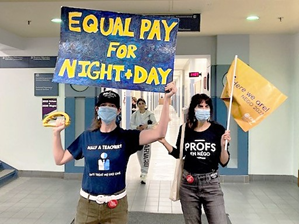
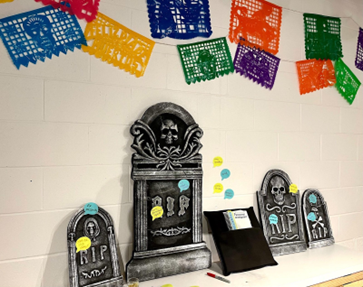
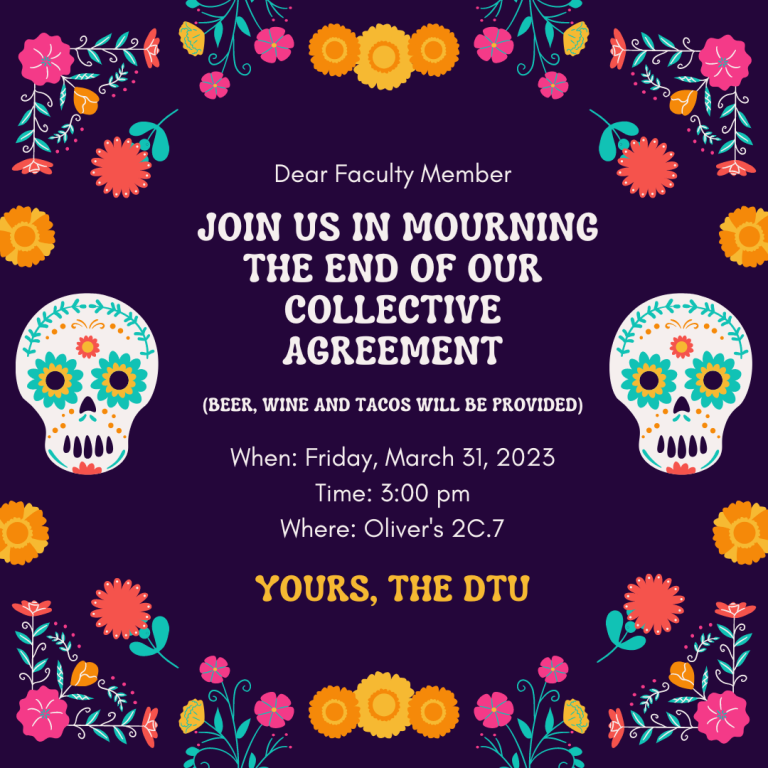
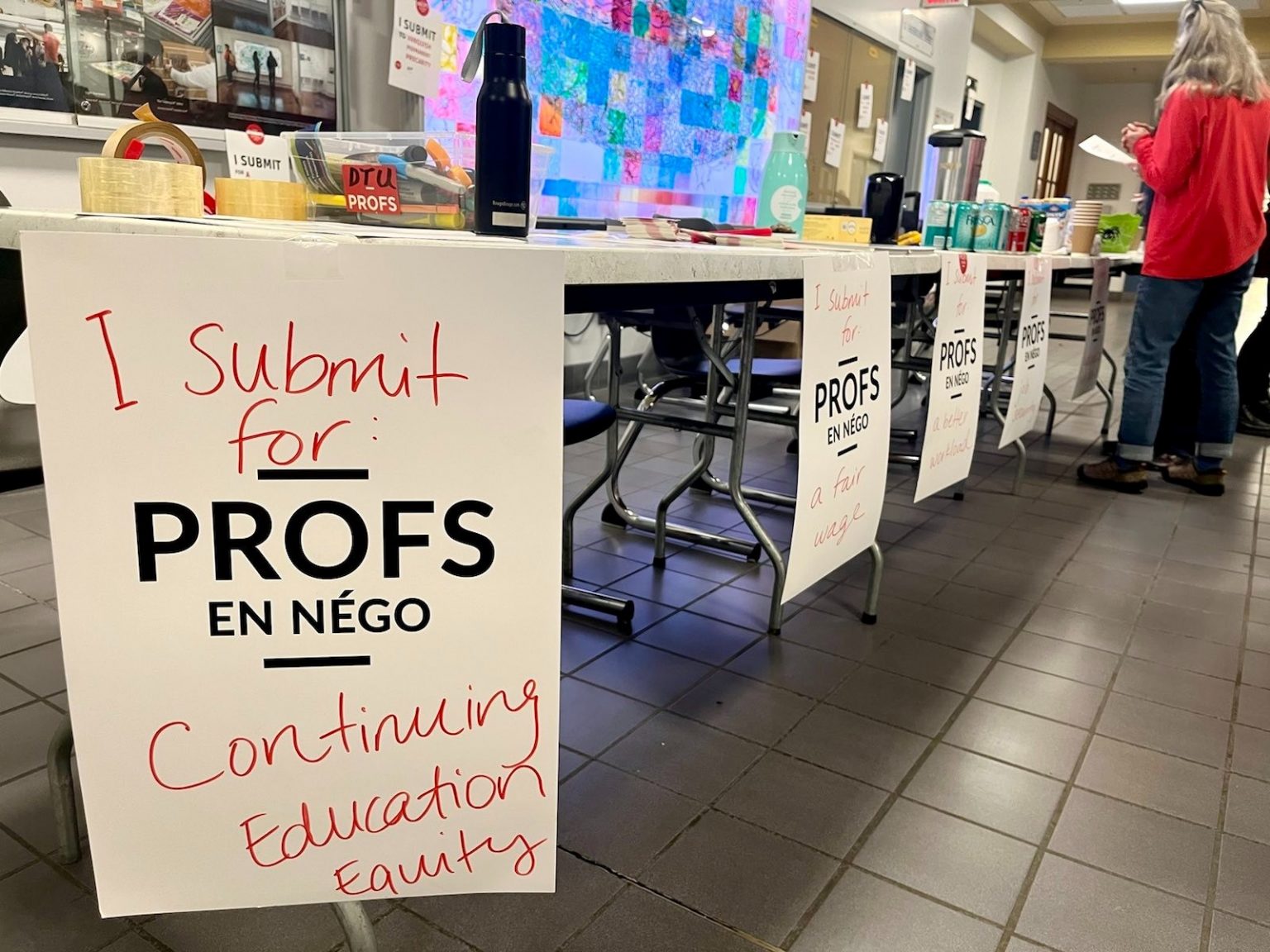
We’ve had a full slate of mobilization activities this semester. Over the past few months, we’ve used the info booth to distribute hundreds of négo t-shirts, stickers, hats, badges, pins, lanyards, tote bags…and donuts, macaroons, cupcakes, and hamantaschen. We came together to mark the expiration of our Collective Agreement in a funerary commemoration. We’ve paraded down the hallways making righteous noise to show the administration that we’re prepared to fight for a fair contract. Just last week, we handed out 2000 Timbits to Dawson students taking the English Exit Exam, emphasizing the common interests of students and teachers as we fight to protect higher education in Quebec. We’ve also spoken with hundreds of DTU members about precarity, salaries, the paltry government offers -peanuts!- , and our collective hopes for the next contract. If the government doesn’t make a realistic offer over the summer, we may well have to intensify the pressure next semester. We’re looking forward to seeing each and every teacher joining in solidarity. 

Invite the DTU to your department meeting!

If you’ve been following the négo news, you will know that it seems highly unlikely that negotiations will be settled over the summer. Although it feels a while away, we are starting to think ahead for mobilization and pressure tactics for the Fall. As part of this, we are offering to come to department meetings at the beginning of the Fall semester to discuss negotiations and hear from members about possible next steps. We know that the first meeting of the semester is often a busy time, but we encourage you to consider including us on your Agenda. 

Final Grade Deadline

Teacher Availability

The deadline for all teachers to submit final grades is June 2. This deadline is the same whether you teach day courses or Continuing Education courses, and whether or not your course includes a final exam in the final examination period.

Important message for non-permanent teachers

We encourage you to consult the DTU before you refuse any workload you have been offered. Refusals can have a substantial impact on your future hiring priority. Teachers who would like to learn more about seniority, priority, and workload distribution are welcome to stop by the DTU office in room 8A.11, or to send us an email at dtu@dtu.qc.ca.

For teachers with a day contract or a cont’ed charge, the last day of availability is June 14. The vacation period is from June 15 to August 16, inclusive. Teachers are expected to be available to the College until the vacation period begins. Although the nature of our work alters after classes end, teachers are expected to fulfil any departmental obligations as well as to be available to attend meetings with the College if required. For full-time teachers, availability is 32.5 hours per week. For part-time teachers, availability is proportional to the workload. 

Teachers who wish to be unavailable to the College prior to the beginning of the vacation period, or after the end of the vacation period, can request a transfer of availability. You need to complete the form provided by the College in advance of the period you are transferring. Note that the form asks teachers to indicate what activities you propose to make up for the period of unavailability; you do not have to provide too much detail here. It is sufficient to indicate something along the lines of “course prep” or “departmental work”. If you perform tasks such as answering MIOs during your transfer of availability, you can ask your Dean to reduce the time that you owe back to the College in availability.


Administrative overreach on pedagogical concerns

This semester there have been several concerning instances of administrators interfering in pedagogical decisions that we consider to be the prerogative of departments and teachers.

In response to the adoption of the Blended Learning policy at senate in February, several departments engaged in discussions about how to proceed. The English department held a special meeting dedicated to this topic, the outcome of which was that a motion was passed stating: The Department of English will continue to discuss blended learning but will not allow any blended courses in the 2023-2024 academic year. In response to this motion, Dean Cole sent an email to all members of the English Department stating that the Blended Learning Policy is a College policy and that the department had a responsibility to review proposals. The College’s position seems to be that an individual teacher can apply to teach a Blended Learning course, even if their department is not in agreement, and that it is the Sector Dean who decides whether to approve the proposal. The DTU’s position is that such pedagogical decisions belong to departments and that faculty members are expected to abide by departmental policies. We feel that it sets a dangerous precedent to suggest that the Sector Dean can determine which members of a department have to follow which departmental policies. 

More recently, a Sector Dean instructed a teacher to alter their assignment parameters despite the fact that the assessment was already in process. In response to an increase in plagiarism on initial assessments, the teacher decided to alter the parameters of the final assessment from an at-home assignment to an in-class assignment spread over several classes. The teacher informed the students several weeks in advance of the assignment and received no feedback. Subsequent to the first class of the assignment, the teacher received a MIO from their Sector Dean stating that they had been made aware of the change by a student. The Dean stated that they considered the change to be a substantive change to the Course Outline and that according to ISEP any substantive change requires approval from the department coordinator and the Sector Dean’s office. However, there is no clear information provided to faculty regarding what the College considers to be a substantive change requiring “approval” from the Dean. Moreover, after discussing the issue with the teacher in question and several of their department colleagues, it does not appear that this is considered to be a “substantive change” by the disciplinary experts. We have brought this issue to the College. 

We advise you to prepare your Course Outlines in such a way as to allow for adjustments over the course of the semester in response to pedagogical need

Know Your Rights

Grade Review Committees

As the Final Grade deadline approaches, we feel it is important to remind teachers of the process for grade reviews. While students’ rights and responsibilities regarding grade reviews are set out in ISEP, the Grade Review Committee is part of our Collective Agreement. 

Before a student requests a grade review, they should be encouraged to discuss the situation with their teacher. A student can request a grade review only once the final grade for the course has been submitted to the College. The student’s request must be submitted to the relevant Sector Dean within 30 calendar days of the official grade deadline of the semester. The Dean determines whether to grant a grade review request from a student, and in the event that the request is granted, they contact the department to ask that a Grade Review Committee be convened. 

A few things to keep in mind about how the Grade Review Committee functions:

  • It is an independent committee; the administration has no authority over how the committee functions.
  • It is composed of three teachers from the discipline, one of which is the teacher responsible for the original evaluation.
  • The committee determines among itself how it wishes to function; for example, whether to meet in person, whether to make its decision via email, the distribution of tasks among committee members.
  • The committee determines whether or not it feels it is necessary to meet with the student; the student has an obligation to present their case along with supporting evidence as part of the request process. 
  • The committee communicates its decision to the Dean; the committee can determine to increase, decrease or maintain the original grade.
  • The decision of the Grade Review Committee is final.

EDIA training

The College’s Local Advisory Committee on Equal Access to Employment, which is meant to work to redress underrepresentation of minority groups in the employee population, held its first meeting of the semester only on May 19th. Meanwhile, departments continue to push for more equity, diversity, inclusion, and accessibility measures at Dawson. You don’t need to wait for the College to act! The Department of Sociology and Political Science recently secured funding from the College for an EDIA workshop designed for them by an external facilitator. Reach out to dtu@dtu.qc.ca if your department is interested in doing something similar.    

We sent the DTU Equity and Diversity Committee’s Departmental Toolkit to all members on April 27th, 2023 – we encourage you to check it out for other suggestions to improve equity in your department.

Non-Permanent Teachers: When is the workload official?

Although you may have been informed of your workload by your coordinator, it is important to know that this workload is only provisional. The official confirmation of workloads is done by Human Resources once they have received the information regarding possible incoming MEDs. The official confirmation usually happens in July and will be subsequently communicated to you.

What is a MED?
Our Collective Agreement includes protections for permanent teachers when there is not a full-time workload available  at their College. Teachers in these situations are referred to as MEDs (mis en disponibilité).  When a teacher becomes a MED it may result in them having priority to teach in another College. 

If there is a full-time workload available at Dawson, MEDs from another College will have  priority over non-permanent teachers at Dawson in certain circumstances. 

If you would like more information about MEDs the FNEEQ has an explanatory guide that can be downloaded here

Owl Hoots 563_2

March 28, 2023                                                 Issue 563

Owl Hoots

Inside this issue

Union Dues Holiday
College Services Survey
Faculty Availability and Vacation Period

The DTU Executive
Louisa Hadley, President
President@dtu.qc.ca
Brian Seivewright, VP Internal
VPInternal@dtu.qc.ca
Mélanie Beck, VP External
VPExternal@dtu.qc.ca
Antonia Fikkert, Secretary-Treasurer
Secretary_Treasurer@dtu.qc.ca
Emilie Richer, Grievance Officer
grievanceofficer@dtu.qc.ca

Administrative Assistant
Elisabeth Leone
Elisabeth@dtu.qc.ca
DTU email: dtu@dtu.qc.ca


Union Dues Holiday

You may have noticed in your current pay statement that there is an amount of 0.00 in the “current” column for Union Dues. This is not a mistake; the DTU Executive asked the College not to deduct Union dues for this pay period as the General Assembly had approved a Union dues holiday for Winter 2023 as part of the 2021-2022 budget. 

Deductions for Union dues will resume for the subsequent pay period.

College Services Survey

The DTU’s surveys on College services are open until March 31st

If you have not yet given your feedback about services such as HR, your Dean’s office, and the OAD, we invite you to do so before the deadline.

Click here to answer the first survey about services that support teaching such as the Bookstore, Printshop, IT services, Student AccessAbility Centre (SAAC), Sector Dean’s Office, Student Services Office, Office of Academic Development (OAD), and Student Services.

Click here to answer the second survey about more general services such as Human Resources, Payroll, Benefits, Offices of the Sector Deans, Facilities Management (FAMA), and Security.


Faculty Availability and Vacation Period

The College has finalized our vacation period for this summer. Unless you are teaching during the Summer semester, your last day of availability is June 14th. The College memo is a little confusing because it lists June 15th as a day in lieu of St. Jean Baptiste with vacation officially beginning on June 16th. The important thing is that you are off for the summer starting on June 15th.

The first day of availability after summer is August 17th; the first day of classes is August 21st.

Dawson Teachers Union
3040 Sherbrooke, Westmount, Suite 8A.11
514-931-8731 ext 1799
dtu@dtu.qc.ca


owl560_updated

The DTU Executive
Louisa Hadley, President
President@dtu.qc.ca
Brian Seivewright, VP Internal
VPInternal@dtu.qc.ca
Mélanie Beck, VP External
VPExternal@dtu.qc.ca
Antonia Fikkert, Secretary-Treasurer
Secretary_Treasurer@dtu.qc.ca
Emilie Richer, Grievance Officer
grievanceofficer@dtu.qc.ca

Administrative Assistant
Elisabeth Leone
Elisabeth@dtu.qc.ca
DTU email: dtu@dtu.qc.ca

In this Issue:

Common Front Mobilisation
Local Mobilisation
Union Dues Holiday
Ventilation Issues
Pub Night
November is Insurance Month
Voluntary Workload Reduction
Scholarity Evaluations
Retirement and RREGOP


Common Front Mobilisation

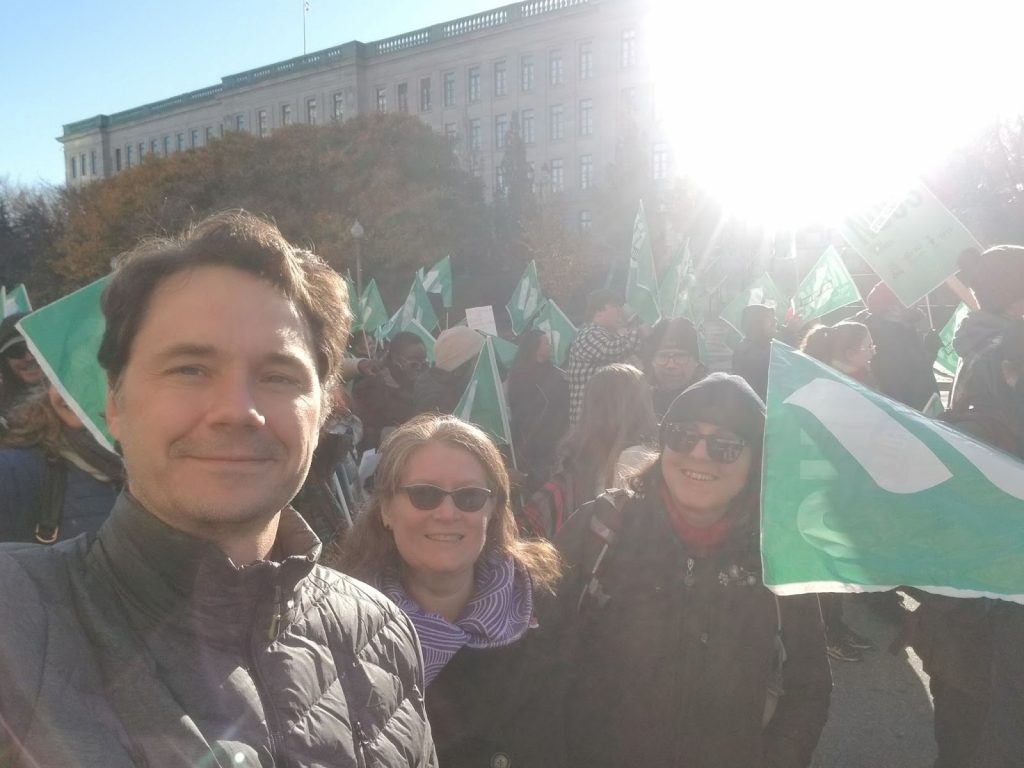
On Friday, October 28, members of the DTU Executive participated in a demonstration to launch the Common Front for the 2023 round of Negotiations. We joined representatives from CSN, CSQ, FTQ and APTS unions in Quebec City in a show of solidarity as we marched to the Ministry to present our central table demands. 

Local Mobilisation

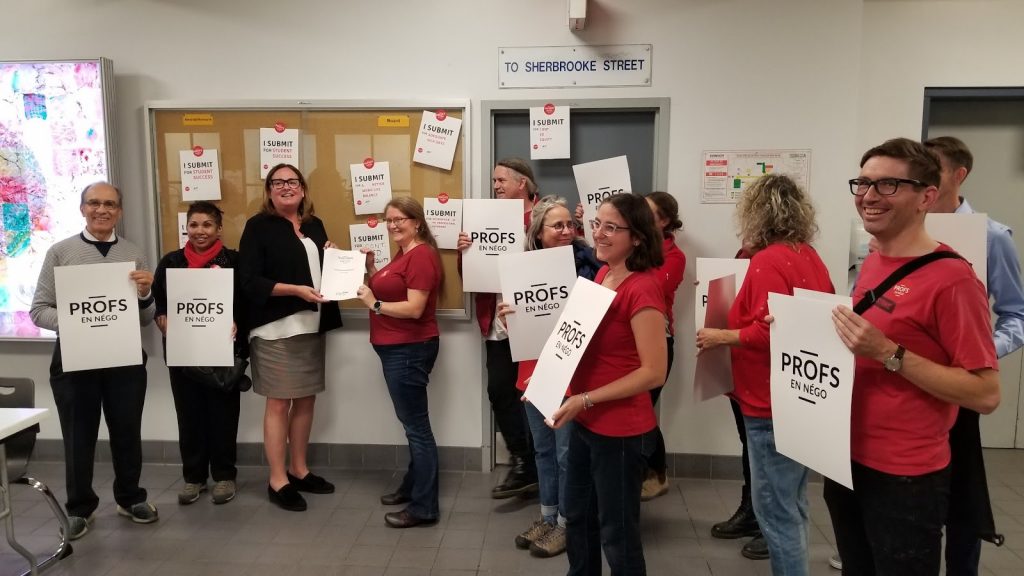
On November 1, teachers at Dawson met with Diane Gauvin to deposit a copy of our Sectoral Table demands, which were submitted to the CPNC on October 21. You can read the initial sectoral demands on our website, in English or in French. 

As negotiations ramp up, there will be more local actions and more opportunities for you to have your voices heard! Keep an eye out for information on how to get involved!

Union Dues Holiday

After closing its budget for 2020-2021 and reviewing its financial position, the DTU Executive assessed that there is a sufficient accumulated surplus to allow for a dues holiday for all members, as we have done in the past. At the General Assembly in which the budget for 2021-2022 was approved, the DTU Executive proposed two Union dues holidays, one for Fall 2022 and one for Winter 2023, which were approved.

The first of these Union dues holidays will be for the pay period of 13 to 26 November 2022. The DTU Executive has asked the College not to deduct dues for this pay period. On the pay statement of 24 November, there should be an amount of 0.00 in the “current” column for Union dues. Deductions for Union dues will resume for the subsequent pay period. 

Ventilation Issues

Several teachers have reported issues with ventilation in their classrooms. Although some of these issues appear to have been resolved, if you are experiencing problems in your classroom or office, we invite you to email Jorge Sanchez directly (jsanchez@dawsoncollege.qc.ca) and copy the DTU (dtu@dtu.qc.ca).

November is Insurance Month!

During the month of November, you have the opportunity to make changes to your insurance coverage. Changes will take effect on January 1, 2023. Note that there have been some recent modifications to the insurance policy which will affect both your coverage and your premiums. You can check out more details

Info-insurance in English:
Info-insurance in French

 If you wish to alter your plan, you should contact Allison Freund in Human Resources.  

Voluntary Workload Reduction Requests

If you wish to apply for a Voluntary Workload Reduction for Winter 2023, the deadline is November 15. You should email Cristina Stanciu in Human Resources at hrfaculty@dawsoncollege.qc.ca. We suggest that you copy the DTU on this email at dtu@dtu.qc.ca. 

Scholarity Evaluations

Our FNEEQ representatives on the Scholairty Committee have informed us of some issues that have been identified with the evaluation of scholarity in two very specific situations. If either of the situations below apply to you, please contact the DTU (dtu@dtu.qc.ca) so that our representatives can look into your case.

  1. You completed two DEC programs, one of which was in a technical program and one of which was a pre-University program. 
  2. You completed a Specialist Diploma based on the USSR educational system or a Kandidat Nauk. Evaluation rules have recently been changed for these.

Retirement and RREGOP Training

FNEEQ is providing an online training session on retirement and RREGOP for members, which will include information about how to buy back leave periods. The training will take place on Tuesday,  November 29 from 5pm until 7pm. If you wish to attend this training, please email the DTU (dtu@dtu.qc.ca) by noon on Friday, 18 November. A Zoom link will be sent to registered participants nearer the time. 

Owl 558

September 1, 2022                                                 Issue 558

Owl Hoots

Inside this issue

Welcome Back!
Upcoming Events
Climate Strike – 23rd September 2022
New Teachers Information Session
Bill 96
College’s Memo on Continuing Education
College Readiness
Dawson College Financial Aid Office 
Food Bank  & Snack Centre

The DTU Executive
Louisa Hadley, President
President@dtu.qc.ca
Brian Seivewright, VP Internal
VPInternal@dtu.qc.ca
Mélanie Beck, VP External
VPExternal@dtu.qc.ca
Antonia Fikkert, Secretary-Treasurer
Secretary_Treasurer@dtu.qc.ca
Emilie Richer, Grievance Officer
grievanceofficer@dtu.qc.ca

Administrative Assistant
Elisabeth Leone
Elisabeth@dtu.qc.ca
DTU email: dtu@dtu.qc.ca

Welcome Back!

We hope that the new semester is off to a great start. As always, we invite you to drop by our office in 8A.11. We can answer questions regarding workloads, seniority and priority, schooling and work experience documentation, and anything else related to working at Dawson. In particular, before turning down work we encourage you to come and discuss the implications with us. You can also call us at local 1799, or email us at dtu@dtu.qc.ca with any questions. 

Upcoming Events

Our first General Assembly of the year will be held on 15th September at 2pm in 5B.13; lunch will be served at 1:30pm. This is an important opportunity for you to provide your feedback on the priorities for the upcoming negotiations as well as on the “Bargaining Projects” documents prepared by the FNEEQ and CSN negotiating teams. The documents are available in English and French on the Négo 2023 section of our website. 

Climate Strike – 23rd September 2022

As part of ongoing action around the climate crisis, Travailleuses et Travailleurs pour la Justice Climatique are inviting unions to consider participating in a Climate Strike on September 23rd. This issue was discussed at the recent Executive Council meeting and will be brought to the General Assembly on September 15th. If the General Assembly votes to hold a strike vote, it will be open to  all DTU members via referendum. We encourage you to participate in the important discussions around this issue at the GA.


The DTU invites New Teachers to an information session on Monday 12th September at 4:30pm in the Rose Lounge (7C.5).

Come out to meet your Union representatives and get information on your contracts, workload and anything else you might be interested in.

Please RSVP at dtu@dtu.qc.ca

Bill 96

As you know, Bill 96 was passed into law in May, so the focus has now moved to implementation. Unfortunately, there has been no concrete information communicated regarding either the timeline or the process of implementation. It is our understanding that Dian Gauvin is involved in committees concerning the implementation, although those discussions are in-camera. We have been informed that the Ministry of Education will be providing more information to the English Colleges in October. 

Next week, the DTU Executive will be attending a special meeting of the Conseil Fédéral to discuss Bill 96. The Conseil Fédéral brings together representatives of all FNEEQ unions, not only Cegeps, but also universities and the private sector. The Executive will inform members of any updates from the meeting. 

College’s Memo on Continuing Education 

Shortly before the start of semester, the Continuing Education office sent out a Memo to Continuing Education faculty which contained many errors and included directives that contravened Quebec’s labour code. 

The DTU immediately contacted the Dean of Continuing Education, along with several other members of the College administration, but have yet to receive a response. Moreover, the Continuing Education office has not responded to the individual Continuing Education faculty who have directly reached out for clarification regarding certain issues, such as whether they will be paid to invigilate Final Exams. Clearly, this causes issues for teachers who are trying to plan their courses.

The DTU also sent an email to coordinators and Continuing Education faculty including some clarifications and corrections on sick leaves, Comprehensive Examinations, and the expectations around encadrement. We invite Continuing Education faculty to contact us with any specific questions relating to these issues. 

College Readiness

The return to classes this semester was once again marred by the College’s lack of readiness. We heard from teachers that classrooms and hallways were unclean and that there was overflowing garbage. Additionally, in the first week of semester, there were repeated issues with the elevators in the A/B wings and at one point none of the elevators were operational. Clearly this causes accessibility issues for teachers and students. The DTU will be raising these concerns with the College.

Dawson College Financial Aid Office Food Bank & Snack Centre

Stocked through the generosity of the Dawson College community, a small food bank is available for students whose monthly income does not cover all their needs.

 Please consider dropping off some items at the Financial Aid Office (Room 4E.2-8). They’re often in need of the following items:

  • canned proteins (salmon,
    tuna, sardines, turkey, chicken, ham,
    beef, etc)
  • canned vegetables (corn, peas, string beans,
    mushrooms, potatoes, tomatoes, spinach,
    carrots, etc)
  • fruits (cocktail, pears, peaches,
    applesauce, mandarin, etc)
  • rice (long grain, basmati, Uncle Ben’s,
    Dainty, Minute Rice, etc)
  • pasta sauces
  • prepared soups, Chef-Boy-R-Dee,
    Kraft dinner, chili, 
  • personal hygiene items (soap, shampoo,
    pads, tampons, deodorant,
    toothpaste/brushes/mouthwash, etc)
  •  cereal, crackers, nuts, treats of all kinds
  • vegan/gluten free items

Dawson Teachers Union
3040 Sherbrooke, Westmount, Suite 8A.11
514-931-8731 ext 1799
dtu@dtu.qc.ca


Owl 558

September 1, 2022                                                 Issue 558

Owl Hoots

Inside this issue

Welcome Back!
Upcoming Events
Climate Strike – 23rd September 2022
New Teachers Information Session
Bill 96
College’s Memo on Continuing Education
College Readiness
Dawson College Financial Aid Office 
Food Bank  & Snack Centre

The DTU Executive
Louisa Hadley, President
President@dtu.qc.ca
Brian Seivewright, VP Internal
VPInternal@dtu.qc.ca
Mélanie Beck, VP External
VPExternal@dtu.qc.ca
Antonia Fikkert, Secretary-Treasurer
Secretary_Treasurer@dtu.qc.ca
Emilie Richer, Grievance Officer
grievanceofficer@dtu.qc.ca

Administrative Assistant
Elisabeth Leone
Elisabeth@dtu.qc.ca
DTU email: dtu@dtu.qc.ca

Welcome Back!

We hope that the new semester is off to a great start. As always, we invite you to drop by our office in 8A.11. We can answer questions regarding workloads, seniority and priority, schooling and work experience documentation, and anything else related to working at Dawson. In particular, before turning down work we encourage you to come and discuss the implications with us. You can also call us at local 1799, or email us at dtu@dtu.qc.ca with any questions. 

Upcoming Events

Our first General Assembly of the year will be held on 15th September at 2pm in 5B.13; lunch will be served at 1:30pm. This is an important opportunity for you to provide your feedback on the priorities for the upcoming negotiations as well as on the “Bargaining Projects” documents prepared by the FNEEQ and CSN negotiating teams. The documents are available in English and French on the Négo 2023 section of our website. 

Climate Strike – 23rd September 2022

As part of ongoing action around the climate crisis, Travailleuses et Travailleurs pour la Justice Climatique are inviting unions to consider participating in a Climate Strike on September 23rd. This issue was discussed at the recent Executive Council meeting and will be brought to the General Assembly on September 15th. If the General Assembly votes to hold a strike vote, it will be open to  all DTU members via Referendum. We encourage you to participate in the important discussions around this issue at the GA.


The DTU invites New Teachers to an information session on Monday 12th September at 4:30pm in the Rose Lounge (7C.5).

Come out to meet your Union representatives and get information on your contracts, workload and anything else you might be interested in.

Please RSVP at dtu@dtu.qc.ca

Bill 96

As you know, Bill 96 was passed into law in May, so the focus has now moved to implementation. Unfortunately, there has been no concrete information communicated regarding either the timeline or the process of implementation. It is our understanding that Dian Gauvin is involved in committees concerning the implementation, although those discussions are in-camera. We have been informed that the Ministry of Education will be providing more information to the English Colleges in October. 

Next week, the DTU Executive will be attending a special meeting of the Conseil Fédéral to discuss Bill 96. The Conseil Fédéral brings together representatives of all FNEEQ unions, not only Cegeps, but also universities and the private sector. The Executive will inform members of any updates from the meeting. 

College’s Memo on Continuing Education 

Shortly before the start of semester, the Continuing Education office sent out a Memo to Continuing Education faculty which contained many errors and included directives that contravened Quebec’s labour code. 

The DTU immediately contacted the Dean of Continuing Education, along with several other members of the College administration, but have yet to receive a response. Moreover, the Continuing Education office has not responded to the individual Continuing Education faculty who have directly reached out for clarification regarding certain issues, such as whether they will be paid to invigilate Final Exams. Clearly, this causes issues for teachers who are trying to plan their courses.

The DTU also sent an email to coordinators and Continuing Education faculty including some clarifications and corrections on sick leaves, Comprehensive Examinations, and the expectations around encadrement. We invite Continuing Education faculty to contact us with any specific questions relating to these issues. 

College Readiness

The return to classes this semester was once again marred by the College’s lack of readiness. We heard from teachers that classrooms and hallways were unclean and that there was overflowing garbage. Additionally, in the first week of semester, there were repeated issues with the elevators in the A/B wings and at one point none of the elevators were operational. Clearly this causes accessibility issues for teachers and students. The DTU will be raising these concerns with the College.

Dawson College Financial Aid Office Food Bank & Snack Centre

Stocked through the generosity of the Dawson College community, a small food bank is available for students whose monthly income does not cover all their needs.

 Please consider dropping off some items at the Financial Aid Office (Room 4E.2-8). They’re often in need of the following items:

  • canned proteins (salmon,
    tuna, sardines, turkey, chicken, ham,
    beef, etc)
  • canned vegetables (corn, peas, string beans,
    mushrooms, potatoes, tomatoes, spinach,
    carrots, etc)
  • fruits (cocktail, pears, peaches,
    applesauce, mandarin, etc)
  • rice (long grain, basmati, Uncle Ben’s,
    Dainty, Minute Rice, etc)
  • pasta sauces
  • prepared soups, Chef-Boy-R-Dee,
    Kraft dinner, chili, 
  • personal hygiene items (soap, shampoo,
    pads, tampons, deodorant,
    toothpaste/brushes/mouthwash, etc)
  •  cereal, crackers, nuts, treats of all kinds
  • vegan/gluten free items

Dawson Teachers Union
3040 Sherbrooke, Westmount, Suite 8A.11
514-931-8731 ext 1799
dtu@dtu.qc.ca


Owl556

THE OWL HOOTS No. 556
Issue No. 556
14 April, 2022

Contact
dtu@dtu.qc.ca
514.931.8731 x 1799
fax 514.931.0761
www.dtu.qc.ca
Dawson College, Room 8A.11
3040 Sherbrooke West
Westmount, QC.
H3Z 1A4

The DTU Executive
Brian Seivewright, President
President@dtu.qc.ca

Louisa Hadley, VP Internal
VPInternal@dtu.qc.ca

Mélanie Beck, VP External
VPExternal@dtu.qc.ca

Antonia Fikkert, Secretary-Treasurer
Secretary_Treasurer@dtu.qc.ca

Oran Magal, Grievance Officer
grievanceofficer@dtu.qc.ca

Administrative Assistant
Elisabeth Leone
Elisabeth@dtu.qc.ca

College Refuses Conversion For Continuing Education Teacher 

The DTU is both disappointed and disheartened by the College’s recent position to refuse that a teacher in the History department be allocated a replacement workload that would allow them to convert their Continuing Education courses into Regular paid courses.

For context, a replacement workload recently became available in History. All available teachers in the department, apart from one, are currently either fully employed or not interested in taking on the replacement this late in the semester. Nevertheless, the College authorized the department to proceed with double employment.

Although a teacher is available and willing to take on the workload, the College is refusing that they take it on as they consider it too costly. We’re troubled by this position for the following reasons:

  • The College prefers that someone with a full annual salary be double employed and receive “extra” remuneration over a part-time teacher.
  • The College is refusing access to the replacement to the part-time teacher, which would give them access to an annual salary, despite the fact that they will have taught more courses than many of their regular day colleagues. Moreover, this part-time teacher does not qualify as double employed.
  • The College is making a decision based purely on financial motivations, rather than considering what is best for their employees and students.
  • Although conversions are costly, the DTU is of the opinion that the costs are warranted in situations like these if it allows teachers with full workloads to obtain an annual salary and better working conditions.
  • The College has now directed the History department to proceed with hiring a new teacher for the replacement workload. This makes absolutely no sense, because the new teacher has no prospect of working in the department for the foreseeable future. It will generate significant work for the department: both in terms of hiring and mentorship, which will be futile since the candidate will likely leave. Furthermore, the new teacher will enter the classroom late in the semester, with no knowledge of departmental policies, the students’ abilities, or the appropriate expectations for students. Classes are currently being canceled until a new hire can be found. All of this is detrimental to the students and will continue to be so.

We asked that the College reconsider its position, both for pedagogical reasons and the impact it will have on the teacher’s working conditions. The department is already facing the prospect of very difficult semesters ahead, as was outlined in the Memo on the Redistribution of Social Science Methods Courses sent at the end of last semester. Within this context, it is disheartening that the College is preventing a teacher from acquiring an annual salary on the basis of cost savings. We are still awaiting a response. Despite the coordinator having already done the call-out and verifications, the administration is bypassing the departmental coordination and contacting individual teachers to ask that they step into the classroom.

Upcoming Deadlines

Professional Development Leave Requests
Although there is no contractual deadline for applications for a professional development leave, the College requests that applications for the Fall semester be submitted by April 15th. The application form is available on the College website.

Sabbatical Leave with Anticipated Salary
The Collective Agreement does not specify a deadline for requesting a sabbatical leave. However, the College requests that teachers apply for a sabbatical leave during the Fall semester by April 15th. The application form is available on the College website.

***Note that since these deadlines fall during the long weekend, the deadline will be the first working day after that i.e. Tuesday, 19th April ***

Voluntary Workload Reduction
The deadline for applications for a VWR for the Fall semester is May 15th. The application form is available on the College website.

Professional Development Fund Applications
Professional Development Funds are available to all faculty (whether in the Regular or Cont. Ed. sector) and can be used to fund professional development activities such as attending workshops, participating in conferences, and taking courses. Teachers can also apply for a reimbursement of up to $100 for computer equipment.

The PDF committee meets several times a semester. Applications should be submitted to pdfsecretary@dawsoncollege.qc.ca for consideration at the next meeting.

Retro Pay

The College processed all the retroactive pay, both the lump sum amounts and the salary increases, on the pay of March 31st for teachers currently employed at the College. You should have received several pay statements with the various retroactive payments separated. Don’t hesitate to come see us with your pay statements if you are unsure of the amounts.

Anyone who taught at Dawson after April 1st 2019 but who is not currently employed by the College should have received an email from us asking them to communicate with payroll to request their retroactive pay. The College has 120 days to process the retroactive pay from the point at which you contact them; however, it seems that the College is moving more quickly in processing the payment.

***Note: If you have full-time employment elsewhere for any of the semesters in the 2022-2023 Academic year, you must indicate on your GOS that you will be “double employment”. Once the GOS has been submitted, teachers have an obligation to inform the College as soon as there is any change in their Double Employment status. For more information on double Employment, see here.

Obituary for Patrick Powers

Over many years, Patrick Powers, who died on March 13, 2022, contributed a great deal to Dawson College. He was a gifted and inspiring educator who taught Humanities at the New School and later in ‘regular Dawson’ from 1973 until his retirement. He served as Chair of the Humanities Department and spent years as an active member of the DTU, serving as its president for a time. He was a staunch supporter of human rights, active in the struggle against racism and sexism and for gay rights in Montreal and further.  Somehow, all of the above facts do not truly summon Patrick’s presence at his best.  He was very good natured, humorous, and empathic, appreciative of others, glad to lend a hand when needed, and always open to considering change.  Among others, he leaves in mourning his son Jason and his partner, Vincent. (Submitted by Greta Hofmann Nemiroff)

Patrick Powers was a wonderful friend, colleague, and mentor when I started teaching at New School in the early 80’s. He was a compassionate facilitator to his students at New School. Pat’s smile lit up the halls. He dedicated a great deal of time communicating with his students and through his guidance, he helped them to develop their self-actualization despite some extremely challenging situations. Our amazing friendship lasted right until the end. He will be dearly missed. (Submitted by Jacinta Luis, Music department)

For further details please see the attached link:

https://www.dignitymemorial.com/fr-ca/obituaries/montreal-qc/patrick-powers-10630409

Online Pilot Project

As you may recall, the Academic Dean sent a memo to all faculty at the beginning of March to provide more information about the Blended Learning Pilot Project. We believe that this memo fails to address many of the pressing questions that faculty, and the Union, have raised about the Pilot Project since it was first announced last semester.

We have written an open letter to the Academic Dean and the Regular Sector Deans expressing our concerns about the lack of transparency and reiterating key issues that remain unanswered. We invite you to read the full text of the letter and to continue these discussions within your department as you consider what role online pedagogy has in your discipline.

Nego 2023: Consultation Round-Up

As you know, consultations have already begun regarding the next round of negotiations. As part of this process, the DTU has consulted its membership both via a survey and at a recent meeting with two representatives from the FNEEQ negotiating team. There will be more opportunities for consultation and discussion in the coming months; for now, though, we wanted to provide a brief summary of the consultation process so far.

In early February, the DTU distributed a survey to all members soliciting their input on several aspects of our negotiations strategy, from alliances to priorities. We received a reasonable amount of responses to the survey, which informed discussions the DTU Executive participated in at both the FNEEQ and CSN level.

The question of alliances between various unions is a key aspect of any negotiation strategy, and often has to be addressed quite early on in the process. As such, there were several questions in our survey asking whether members believed we should seek an alliance with other public sector unions and, if so, with which unions specifically.

In response to the question “in your opinion, would an alliance with other public sectors bring us better gains in this round?” Almost half of those who responded were unsure. Of those who expressed an opinion, 77% answered “Yes – a common front with as many public sector federations as possible”. In particular, there was a particular preference to ally with other workers in education as well as in health care. More specifically, we also asked “in your opinion, would an alliance with the other cégep teachers federation (FEC-CSQ) bring us better gains this round?” Similarly, almost half of respondents were unsure, but this time 93% of those who expressed an opinion were in favour of an alliance with FEC-CSQ.

The DTU Executive represented these positions at Regroupement, which brings together the Cégep Unions in FNEEQ, and at a meeting of the four federations represented by CSN. Following these discussions, the CSN and FNEEQ have been working to establish the largest possible alliances. A “Common Front” comprised of CSN, CSQ, at FTQ was announced on 3rd April. For more information on the Common Front, see the latest info-négo(in French). At the sectoral level, FNEEQ is in discussions regarding a possible alliance with FEQ-CSQ.

Another key aspect of the negotiation that we consulted members on was the strategy that was adopted in 2020 and what elements should be kept for the upcoming Nego 2023. The Nego 2020 introduced some new approaches to the negotiation strategy; specifically, FNEEQ submitted an initial list of principles that needed to be addressed, and only submitted a list of specific demands after it had received the government’s demands. The FNEEQ also adopted a strategy of consulting its members on demands by a series of “waves”.

The responses to questions on these strategies indicate that many of our members are unsure of the efficacy of these approaches. Of those who expressed an opinion, 75% felt that submitting an initial list of principles was either “very effective” or “somewhat effective”; 66% felt that it was either “very effective” or “somewhat effective” to submit specific demands after receiving the government’s demands; and 77% felt that it was either “very effective” or “somewhat effective” to consult members on waves by a series of demands. However, one of the recommendations that came out of the bilan de la negotiation 2020 at Regroupement was to limit the number of stages in the process of adopting the demands to allow for more focused mobilisation efforts.

Obviously, a key aspect of negotiations is our demands. Although we are not yet at the stage of preparing our specific demands, we did consult members on their priorities for the next round of negotiations. Specifically, we asked respondents to indicate their position on prioritizing salary of working conditions for Nego 2023:

Salary should be prioritized over working conditions 32%
Working conditions should be prioritized over salary 21%
Salary and working conditions should be given equal weight 48%

Clearly, there is concern about both salary and working conditions and, indeed, these concerns were reflected in members’ responses when asked to indicate their top three priorities for the next round of negotiations. The majority of respondents (approx. 66%) indicated either salary or Continuing Education equity as their top priority. The remaining responses highlighted issues to do with working conditions, such as precarity, CI calculations in technical programs, and benefits.

Along with consulting members about the strategies and priorities for negotiations, we also asked about participation in local discussions and the level of information provided by the DTU. Of those that attended General Assemblies, whether frequently or not, 82.3% either agreed or strongly agreed that General Assemblies were informative and 74% either agreed or strongly agreed that General Assemblies allowed for meaningful consultation of members. While we understand the difficulties of attending General Assemblies, especially in the absence of a common non-teaching block for teachers, we encourage you to attend wherever possible to allow for the most meaningful consultation possible.

In addition to the survey, on March 30, we held a consultation meeting with representatives from the FNEEQ negotiating team. All members were encouraged to attend to share their concerns and priorities directly with the negotiating team. Two recurring themes came out of these discussions: the need to build on the gains secured in the last round of negotiations for Continuing Education teachers and the need to address challenges that are specific to the technical programs.

This meeting was part of a “tour” of local unions that the FNEEQ negotiating team undertook in March. The information gathered from these meetings will inform the team as they develop a proposed list of demands. This list will be initially presented to representatives of the various unions at Regroupement next week; these discussions will inform the preparation of the proposed demands which will go to local General Assemblies for consultation in Fall 2022.

Below is the proposed timeline for the next stages of the consultation process:

COVID-19 Testing Protocols

With the ongoing pandemic entering its 6th wave, clear protocols regarding how to handle COVID-19 absences remain necessary. Although the College sent an updated FAQ at the end of March, there remain many inconsistencies in the College’s procedures. We raised these issues at a CRT meeting on 31st March and were told that the College would send an updated document; as yet, we have received no such update.

To highlight just a few of the issues and inconsistencies:

  • The “Updated COVID-19 Absence Procedures” document indicates that employees with symptoms have priority for PCR tests, yet the next line of the document stipulates that a PCR test is mandatory regardless of whether they have symptoms
  • Indeed, the College has been insisting on PCR tests even after teachers have tested positive with multiple rapid tests and are symptomatic. Requiring COVID-positive teachers to get a PCR test is contrary to public health guidelines and jeopardizes teachers’ recovery
  • The College stipulates that the period of isolation is 5 days; however, public health indicates that this is a minimum and that people remain contagious beyond this point. Moreover, the College does not seem to be taking into account that symptoms may continue beyond this timeframe

The College’s treatment of teachers with respect to COVID-19 absences is particularly galling in the context of a semester in which we are being asked to provide accommodations for students with no documentation. Between the start of semester and the beginning of March break, almost 700 students had been granted COVID accommodations. In the three weeks after the return from March break, there have been almost 600 cases of students testing positive for COVID; there has undoubtedly been a similarly exponential increase in the number of accommodations teachers have been required to provide. We urge you to get in touch with us if you contract COVID and would like to discuss your options.